
Health Misinformation and Health & Wellness Coaching
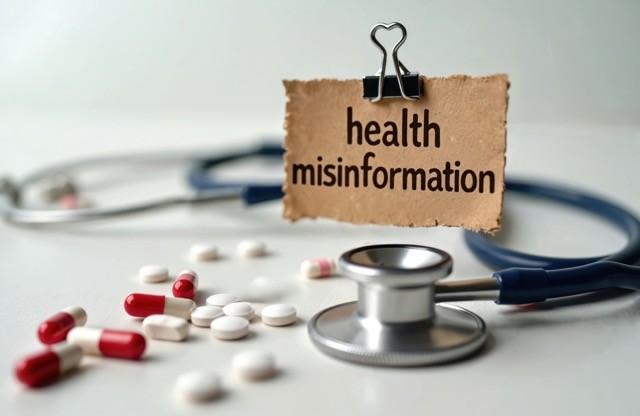
“May you live in interesting times!” is an old Chinese curse, they say. Political instability, healthcare crisis, AI anxiety, the health misinformation “infodemic”, and lots more concerns surround us. Interesting indeed! As we head into a new year how can we do our best to see what’s coming at us and sift out what are true concerns worthy of our attention and what is more like F.E.A.R = False Evidence Appearing Real?

In the last year there has been so much misinformation thrown at us that Politifact has declared 2025 to be The Year of the Lies (https://www.pbs.org/newshour/show/why-politifact-has-labeled-2025-the-year-of-the-lies). Entire conferences, summits and symposiums have exploded in the last couple of years on misinformation and health misinformation (https://truehealthinitiative.org/annual-global-health-misinformation-symposium-9-10-dec-2025-agenda/).
So, we are all challenged to operate with discernment and as health & wellness coaches we can serve our clients best when we help them find trusted resources for health information and to help them identify misinformation. Check out this article from the American Psychological Association Monitor on health misinformation: How to reverse the alarming trend of health misinformation. Experts are studying how false information spreads, who is most vulnerable, and how to end the “infodemic” https://www.apa.org/monitor/2024/07/ending-health-misinformation). The article cites studies that look at how increasing distrust of science, the rise and use of social media as a (if not the) primary source of health information and deliberate misinformation campaigns have driven what some are calling an “infodemic” of falsehoods in a critically important area.
Social Media Messes and Misses
“Research indicates that people tend to share and engage more with false or low-quality information they encounter online, compared with factual information (Allen, J., Integrity Institute, October 13, 2022; Vosoughi, S., et al., Science, Vol. 359, No. 6380, 2018). That’s likely because it’s designed to be engaging and often has an emotional pull. Social media companies have little incentive to police content if it means removing users and advertising dollars from their bottom line.
“A big part of the social media business model is getting eyeballs on the platform…”. Like many stories in social media and even commercial media, the more outrageous or interesting the article the more it gets posted and reposted.
Then there’s the online “influencers”. Again, from the article: “Health misinformation differs from other forms of inaccurate content, such as political misinformation, in a few important ways. For one, health misinformation purveyors often stand to benefit financially by selling a product or service, such as TikTok influencers who have no formal medical training but promote alternatives to hormonal birth control to millions of viewers.”
Artificial “Intelligence” 
AI cannot necessarily be trusted either. Again from the APA article “Artificial intelligence (AI) plays a role in the production and spread of false information about health and other topics, particularly by foreign governments. Malicious bots have generated millions of false social media posts—but the true scope of the problem is still unclear because it can be tough even for experts to tell what content is generated by AI (Hajli, N., et al., British Journal of Management, Vol. 33, No. 3, 2022; Bontridder, N., & Poullet, Y., Data & Policy, Vol. 3, 2021).
The article continues “Once people start accessing and sharing misinformation online, it can be difficult for them to disengage because of the connections they form, Freelon said. Information transfer is a highly social experience that offers a rush of positive feedback—even well-intended people fall into echo chambers where others reinforce their inaccurate information or harmful beliefs.” As we know, online algorithms constantly drive us to more similar information once we have searched in a certain direction or discovered such a direction of content.
 How Health & Wellness Coaches Can Help
While such research by social scientists is helping us to begin to counter health misinformation, what can we, as health & wellness coaches, do to help our clients to navigate the minefield of Health Misinformation? Let’s look at some concrete strategies and coaching methods that may be helpful.
Staying in Our Own Scope of Practice
- The What the How and the Why
Understanding our role and limitations as a health & wellness coach is foundational. Our clients are used to working with consultants and will initially look to us for the same kind of help. WHAT clients could benefit from doing to improve their health and wellness comes from trusted professional sources like physicians, dieticians, various therapists, fitness trainers, etc. Clients are often advised from these sources what they should be doing – the “Lifestyle Prescription”, perhaps part of a Treatment Plan. The huge question for the client is HOW DO I DO IT in my life? The way forward there is what comes from the work with the coach: the Wellness Plan. We also like to say that through the coaching process we help people find their “WHY” – the motivation to follow through with their efforts. See my previous blog post: Clarity on Scope of Practice: The What, the How and the Why of Lifestyle Improvement. (https://realbalance.com/clarity-on-scope-of-practice-the-what-the-how-and-the-why-of-lifestyle-improvement?highlight=WyJzY29wZSIsIm9mIiwicHJhY3RpY2UiXQ==)
- Social conversion vs Coaching conversation
If we are at a coffeeshop with a friend and want to talk about folklore and our experience with navigating a certain diet you’re having a Social Conversation. When we’ve be sharing our own personal knowledge or what we’ve heard from other friends or advice we’ve been given, we’ve got to ask, how valid and reliable is this kind of information. Are we hearing or repeating information that is actually misinformation? If your client wants to talk in a coaching session about the same topic it needs to be a Coaching Conversation. We’ll be conducting a professional coaching session and following a coaching methodology while we stay within our scope of practice. If we’re not qualified to wear a second professional hat (e.g. dietician) we’ll stick to coaching.
- Self-Disclosure and Scope of Practice
Let’s say your client is anticipating a surgery like one you have had or has been diagnosed with a medical condition that you have experienced. Can sharing about your experience be helpful to your client? Possibly, but it depends on how you do it. Check out my blog post: Self-Disclosure in Coaching – When Sharing Helps and Hinders ( https://realbalance.com/self-disclosure-in-coaching-when-sharing-helps-and-hinders?highlight=WyJzZWxmLWRpc2Nsb3N1cmUiXQ==)
 Trust in the Coaching Alliance
- Coaching Presence
The coaching relationship is determined so much by our own way of being. Have we we developed an alliance based on unconditional positive regard and mutual respect where our client can speak without judgment and be heard and understood compassionately? See my blog post: Unconditional Positive Regard: The Being and Doing of Coaching - Part Two (https://realbalance.com/unconditional-positive-regard-the-being-and-doing-of-coaching-part-two?highlight=WyJmYWNpbGl0YXRpdmUiXQ==)
The way we respond when our client starts talking about some health or wellness practice that sounds suspiciously questionable will be critical to our coaching alliance. If we immediately exercise our “Righting Reflex” as the term is used in Motivational Interviewing, and correct our client’s misinformation it could potentially damage the trust we’ve been building. Instead we might immediately use a request for clarification – Oh! Tell me more about that. Then inquire So, where did you hear about that? The key is to do this in a very neutral way. You may discover the client just heard it somewhere or you may discover that the client is very attached to this information. You can then cautiously inquire about the source of their information and help them to consider how they can find out more about it and its validity.
Challenging Assumptions
Whenever you detect that what the client is saying may be an assumption you might challenge your client by asking them So, how do you know that to be true? As you explore this with your client they may begin to realize how they are indeed making an assumption. Your client may also find themselves saying something like Well, I don’t know that to be true, but I’m afraid it is. Now you have a way to help your client to explore this fear that they have and what they are concerned about.
Challenging depends on the level of trust in the coaching alliance. Challenging is sometimes not well received early on in the coaching relationship. Once trust is earned, your client truly knows you have their best interest at heart challenges are usually seen more positively.
Sharing/Finding Reliable Resources 
Helping our clients sift out the wheat from the chaff in the plethora of health and wellness information and misinformation out there can be a daunting task. Here’s some tips that may help:
- Ask permission– ask your client if they would appreciate some resources to help find valid and reliable health/wellness information
- Here’s a resource for HOW to find reliable health information online from the American Medical Association: https://www.ama-assn.org/system/files/helping-patients-find-reliable-info-online.pdf.
- Tip from the article on how to identify safe sites: look for website URL’s ending in .gov and .edu.
- When a client finds an article referencing a particular study in the popular press or media urge them to check out
- The recencyof the study
- The “N”in the study – how many participants contributed data to the study.The popular media is famous for splashing eye-grabbing articles based on single studies with very low n’s, e.g. 36 people.
- Has the study been corroborated by any other research?
- Was the study conducted or funded by a company with a conflict of interest?
- Help your client get curious.Instead of approaching the task of finding valid information as a way of correcting a mistake, show interest and curiosity yourself in discovering what the best information is.Make hunting the answers an adventure!
As health & wellness coaches we always follow a client-centered coaching process. We like to say the client’s agenda is THE agenda. I always like to add that there is a caveat to that statement: except for when the client’s health is potentially threatened. When your client is peddling their bicycle towards the edge of a cliff you need to warn them!

Michael Arloski, Ph.D., PCC, NBC-HWC is CEO and Founder of Real Balance Health Coach Training (https://realbalance.com/). Doctor Arloski is a psychologist, coach and pioneering architect of the field of health and wellness coaching. He and his company have trained thousands of coaches around the world.